Expenses and receipts
Recording what you spend, which costs are allowable, how to claim only the business share of a part-personal cost, and where it all lands on your tax return.
Last checked 12/09/2026.
What it is
Everything you spend on the business that is not already worked out from a shift: parking, your phone, kit, platform fees, an accountant. Fuel and insurance for your driving come from your shifts and your settings, so they are not entered here.
Paid and claimed are two different figures
This is the one idea the page is built around, and getting it the wrong way round is how a return goes wrong.
- Paid is what left your bank account. Every expense counts, allowable or not, because it all comes out of what you actually earn. This is what feeds your true hourly rate.
- Claimed is what comes off your taxable profit. Only entries marked claimable count, and only the business share of them.
The two totals sit side by side at the top of the page for exactly that reason.
Business use, for a cost that is part personal
A phone bill is the case everybody has. The whole bill is real money out, but only the work share is allowable.
Enter the full amount and set business use to the share that is work - 50% for a phone you use half for driving. JoltMile claims that share and keeps the full figure on the record.
claimed = amount paid x business use % (only if the entry is marked claimable)
Entering a reduced figure instead is tempting and worse: your record no longer matches your bank statement, and you cannot correct the split later without remembering what the real bill was.
Which categories are allowable
Every category carries its own guidance, shown as soon as you pick it, and sets the claimable flag for you. You can override it - the flag is a starting point, not a rule.
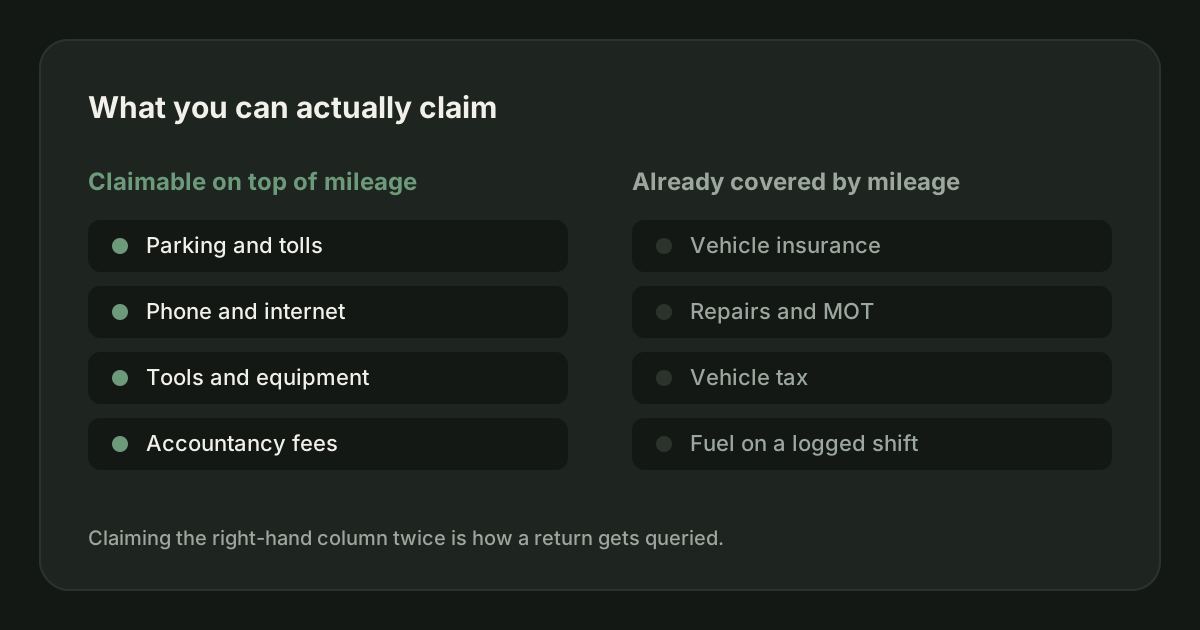
The categories marked not claimable are mostly vehicle running costs: insurance, servicing, MOT, road tax, breakdown cover, and fuel outside a logged shift. That is not an oversight. If you claim the mileage allowance it already covers all of them, and claiming them again is claiming the same cost twice.
Parking fines are the other kind of not-claimable: HMRC does not allow penalties as a business expense, whatever they were for.
The double-claim warning
Mark a vehicle running cost as claimable and JoltMile asks whether you are sure, and explains why it is asking. You can go ahead - it is your return - but the choice is recorded on the entry, shown in its edit history, and flagged on your expenses summary and its exports, so you see it again before you file rather than after.
The exception is if you use the actual costs method rather than mileage, in which case these costs genuinely are claimable and the mileage allowance is not. You pick one method per vehicle and stay with it. Mileage or actual costs works through which suits you.
Receipts
Attach as many photos or PDFs as you like to one expense - an invoice and a card receipt are two documents about the same cost. Images show a thumbnail so you can tell them apart without opening them.
One Upload button does all of it. It asks how: straight to the camera, a picture out of your camera roll, or a file. The camera is the one to use at the pump, before the paper is in a bin.
Receipts travel with your JSON backup, so a full export really is a full export. HMRC expects records kept for at least five years after the 31 January deadline for that tax year.
Recurring expenses
For a cost you pay on a rhythm - a phone bill, insurance by instalment, a subscription. Set the amount and how often, and JoltMile adds each one as it falls due.
- Nothing is ever created in advance. An expense dated next month is not a record, it is a prediction sitting inside a tax figure.
- A start date in the past catches up: everything already due is added straight away.
- Each entry it creates is an ordinary expense. Edit the month the bill was higher, delete one, attach a receipt - none of it disturbs the pattern.
- Pausing or deleting a pattern stops future entries. What it already created stays, because that is a record of money you actually paid.
Importing from a spreadsheet
Finding things again
- Search covers description, supplier, category and amount. Typing 12 finds £12.00 and £12.50, not £112.00.
- Date ranges are anchored on the tax year, 6 April to 5 April, because that is the boundary these records exist for.
- Filters for category, claimed or not, and a date range, with a choice of sort order.
- Select several entries to recategorise, mark claimable or delete them together.
Entries that look like the same cost typed twice - same amount, same category, a few days apart - are flagged as a possible duplicate. It is only ever a flag: buy fuel twice in a week and both are real.
Edit history
Every change to an expense is recorded: what changed, from what to what, and when. It is append-only and cannot be edited. Part of keeping records HMRC would accept is being able to say what an entry said before somebody changed it.
How expenses reach your figures
Claimable expenses come off turnover, along with your mileage allowance, to give taxable profit. For per-shift figures, the year's claimable expenses are spread across shifts in proportion to their earnings, so a big week carries more of the phone bill than a quiet one.
Everything you spent, claimable or not, is subtracted in your current balance and your true hourly rate. That is the difference between what is deductible and what is gone.
Mistakes to avoid
- Logging fuel as an expense while also claiming mileage. See can I claim mileage and fuel.
- Claiming 100% of a phone you also use personally. Set the business share.
- Entering a reduced amount instead of using business use. Your records should match your bank.
- Skipping non-claimable costs. They do not reduce your tax, but they absolutely reduce what you take home.
- Leaving the receipt for later. Photograph it onto the expense while it is still in your hand.
Related
What can I claim on top of the mileage allowance?
Anything that is not a cost of running the vehicle - parking, phone, kit, platform fees.
Mileage & expensesUpdated 19/08/2026
Can I claim mileage and fuel receipts?
No. The mileage rate already includes fuel, along with every other running cost.
Mileage & expensesUpdated 19/08/2026
How JoltMile estimates your tax
Income tax and Class 4 National Insurance on your running profit, using the 2026/27 bands.
HMRC & taxUpdated 29/09/2026
Allowable expenses for delivery drivers: the full list
What you can claim, what you cannot, and the ones that depend on how you have claimed for your vehicle. Written for drivers using the mileage method, because most are.
Mileage & expensesUpdated 20/08/2026
Business miles, commuting and the depot run
A business mile is one driven wholly for the work. Commuting between home and a regular workplace is never claimable. For most gig drivers the working day starts when the app goes on, which makes the drive to a chosen pickup zone personal and the drive between drops business.
Mileage & expensesUpdated 27/08/2026
Record keeping, and how long to keep it
You have to keep enough to show how every figure on your return was arrived at: what you were paid, what you spent, and how far you drove for the work. Records have to be kept for 5 years after the filing deadline for the year they cover.
HMRC & taxUpdated 27/08/2026