Business miles, commuting and the depot run
A business mile is one driven wholly for the work. Commuting between home and a regular workplace is never claimable. For most gig drivers the working day starts when the app goes on, which makes the drive to a chosen pickup zone personal and the drive between drops business.
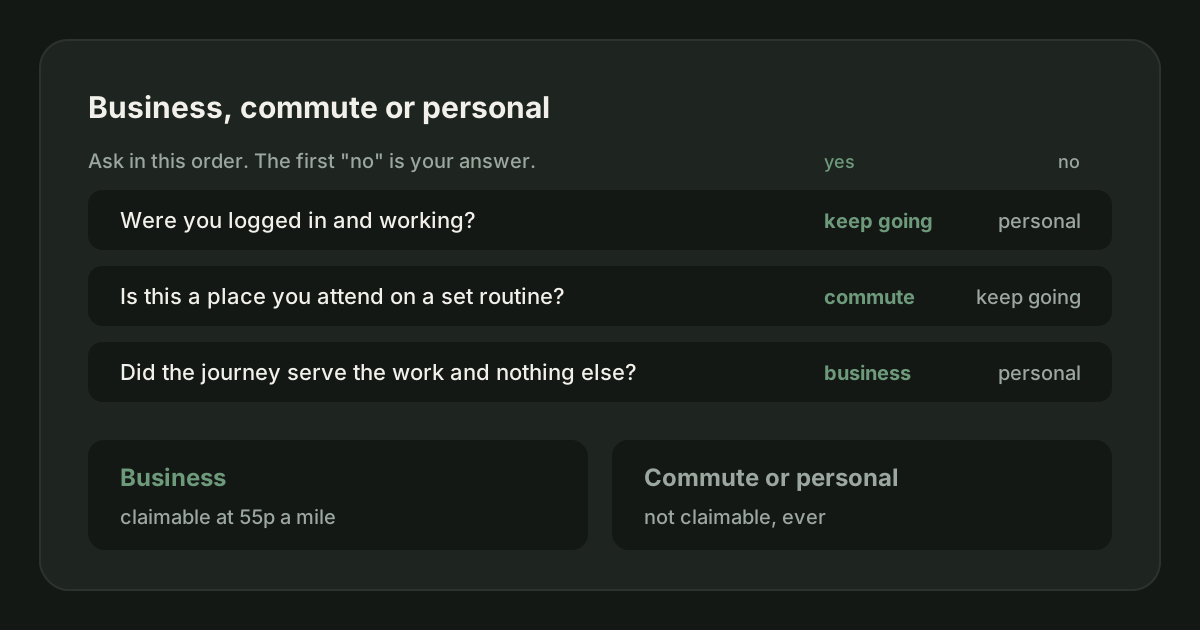
Correct for the 2026/27 tax year. Last checked 12/09/2026.
The mileage claim is usually the largest deduction on a delivery driver's tax return, so which miles count is the single most valuable question in this section. The rule is short and the edges are not.
The rule
A journey is business travel if it is made wholly and exclusively for the purposes of the trade. Travel between home and a regular place of work is not.
Both halves matter. The first lets you claim the miles between drops without argument. The second is what catches the first and last journey of the day.
Why the depot run is the hard case
A parcel courier who attends the same depot every morning at the same time looks, to HMRC, like somebody commuting to work. The fact that they are self-employed does not change that: the test is the pattern of the journey, not the employment status of the person making it.
This was settled in a case about a doctor, Dr Samadian v HMRC (opens in a new tab), who travelled from a home office to private hospitals he attended on a regular timetable. The tribunal accepted his home was a place of business and still refused the travel, because a predictable journey to a habitual workplace is a commute.
Where most gig drivers actually stand
Food delivery on an app is the easiest case. There is no workplace at all: you turn the app on somewhere, you are sent wherever the orders are, and no restaurant is a regular place of work. From the moment you are logged in and available, the miles are business miles.
Amazon Flex sits in the middle. If you take blocks from whichever station has one, the journeys vary and the argument is straightforward. If you take the same 04:00 block from the same station five days a week, that is much closer to a commute.
A fixed round for a parcel firm is the hardest case. The depot is a regular workplace on any ordinary reading, and the honest position is that the run to it is commuting and the round itself is business.
A worked day
| Leg | Miles | Business? |
|---|---|---|
| Home to the station you have taken a block from, first time there | 11 | Yes, on a varied pattern |
| Station, then 42 drops around the route | 68 | Yes |
| Detour to collect shopping mid-round | 4 | No |
| Last drop back to home | 9 | Yes, on a varied pattern |
| Claimable on this day | 88 |
At 55p a mile, 88 business miles is a deduction of £48.40 for one day. Get the same day wrong by treating the four-mile detour as business and the claim is overstated by £2.20, which is small; get a whole year of depot runs wrong and it is not.
How to keep this defensible
- Log the miles on the day, not at the year end. A contemporaneous record is the thing HMRC asks for and the thing almost nobody has.
- Record the purpose of each trip, not just the distance. Business, commute or personal.
- Keep the odometer readings at the start and end of the tax year. Your claimed business miles can never exceed the total the car did.
- Where the first and last legs are arguable, write down why. "Took a block at Croydon because none were offered at Bromley" is the kind of note that answers the question two years later.
JoltMile asks for the purpose of a trip for exactly this reason. It is not a category for tidiness, it is the field that decides whether a mile reaches the claim.
What this is not
This is general information about how HMRC treats travel, not advice on your own position. If you have a fixed round, a single depot and a large mileage claim, that combination is worth an hour with an accountant rather than a guess.
Sources
Common questions
- Is the drive from home to the Amazon Flex station a business mile?
- It depends on whether that station is a regular place of work for you. Attend the same station on a repeated schedule and HMRC can treat it as an ordinary commute, which is not claimable. Take blocks from whichever station offers one, and it is far easier to argue the journey is business travel.
- Can I claim the drive home at the end of a shift?
- Yes, if the last leg is genuinely part of the work journey and not a commute from a regular workplace. The safest position is to log the miles from the first job to the last job, and treat the run out and the run home separately.
- What about driving around waiting for an order?
- Miles driven while logged in and available, in the area you are working, are business miles. Miles driven to get to that area at the start of the day usually are not.
- Does it matter that my home is my business address?
- On its own, no. Having no other premises helps the argument that your home is your base, but HMRC looks at the pattern of the travel rather than at what is written on your registration.
- What is the Samadian case?
- A tax case about a doctor who travelled from home to private hospitals he attended regularly. The tribunal held that travel to a place you attend on a predictable, repeated basis is not business travel even when you work from home. It is the reason a fixed depot is treated differently from a different pickup point every day.
About the author
Issac Davies, Founder of JoltMile
Issac Davies drives for gig apps in the UK and built JoltMile to show drivers what a shift actually pays once fuel, insurance and tax come off. Every guide here is checked against HMRC and gov.uk guidance, and is information rather than tax advice.
Track this automatically
Business mileage · Shift log: the JoltMile app works this out from your own shifts. Your first 10 shifts are free.
Related
The complete mileage guide for delivery drivers
What counts as a business mile, the 55p and 25p approved rates, the 10,000-mile threshold, and whether mileage or actual costs leaves you better off.
Mileage & expensesUpdated 19/08/2026
What counts as a business mile for a delivery driver?
Miles driven for the work itself - not the journey from home to your depot or zone.
Mileage & expensesUpdated 19/08/2026
AMAP (approved mileage allowance payments)
AMAP is the flat per-mile rate HMRC lets you claim instead of working out what your vehicle actually costs. For a car or van it is 55p a mile for the first 10,000 business miles in a tax year and 25p after that.
Mileage & expensesUpdated 27/08/2026
Record keeping, and how long to keep it
You have to keep enough to show how every figure on your return was arrived at: what you were paid, what you spent, and how far you drove for the work. Records have to be kept for 5 years after the filing deadline for the year they cover.
HMRC & taxUpdated 27/08/2026
Renting a PCO car: mileage rate or actual costs?
If you rent your private hire car by the week, you cannot claim both the rental and the mileage rate. Which one to claim depends on the rent, your miles and how much of the week the car works. Here is the arithmetic.
Mileage & expensesUpdated 29/09/2026
Your JoltMile subscription as a claimable expense
Why a JoltMile subscription appears in your expenses automatically, where the figure comes from, and why you cannot edit it.
Mileage & expensesUpdated 29/09/2026