Allowable expenses for delivery drivers: the full list
What you can claim, what you cannot, and the ones that depend on how you have claimed for your vehicle. Written for drivers using the mileage method, because most are.
Correct for the 2026/27 tax year. Last checked 12/09/2026.
An allowable expense is a cost incurred wholly and exclusively for the business. Get the list right and your tax bill drops; get it wrong in either direction and you either overpay or end up defending it.
The single most important thing to establish first is which method you use for your vehicle, because it decides half the list.
If you claim mileage, the vehicle is already covered
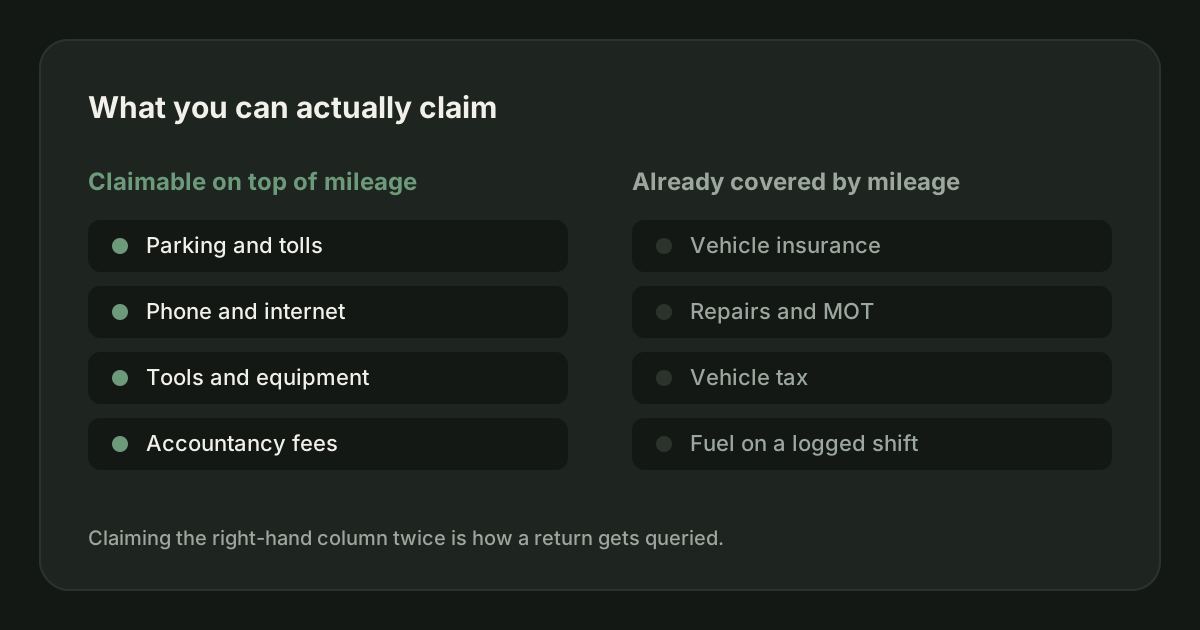
The mileage allowance at 55p a mile is not a fuel allowance. It is a whole-vehicle allowance, and it already includes fuel, insurance, road tax, servicing, repairs, MOT, tyres and depreciation.
Claiming any of those separately on top is claiming twice for the same cost. It is the most common error on a delivery driver's return.
What you can claim on top of mileage
| Cost | Claimable? | Notes |
|---|---|---|
| Parking while working | Yes | Not fines. Meter, car park or app charges during a shift. |
| Tolls and congestion charges | Yes | Incurred on business journeys. |
| Phone and data | Partly | The business proportion. A reasonable, consistent split you can explain. |
| Insulated bags, trolleys, straps | Yes | Equipment bought for the work. |
| Protective and branded clothing | Yes | Hi-vis, waterproofs, branded kit. Not ordinary clothes. |
| Phone mounts, chargers, power banks | Yes | Bought for the work. |
| Accountancy and bookkeeping fees | Yes | Including software subscriptions used for the business. |
| Bank and card charges | Yes | On a business account, or the business share. |
| Public liability or goods in transit cover | Yes | Business insurance, separate from the vehicle policy. |
| Use of home as office | Yes | Simplified flat rate by hours worked at home, or a proportion of actual costs. |
| Training for the work you already do | Sometimes | Updating existing skills, yes. Qualifying for something new, no. |
What you cannot claim
| Cost | Why not |
|---|---|
| Fuel, if claiming mileage | Already inside the mileage rate. |
| Vehicle insurance, tax, servicing, if claiming mileage | Same reason. |
| Parking fines and speeding fines | Penalties for breaking the law are never allowable. |
| Ordinary food and drink while working | Everybody has to eat. Only genuinely exceptional travel meals qualify. |
| Everyday clothing | Even if you only wear it for work. |
| Commuting from home to a regular base | Ordinary commuting, not business travel. |
| The private share of anything | Only the business proportion is ever allowable. |
The ones people get wrong
Food. The rule is not "meals while working are deductible". Ordinary subsistence is a private cost. There are narrow exceptions for occasional travel outside your normal pattern, and delivery driving is almost never that.
Phone. A single bill covering personal and business use is apportioned. Pick a defensible percentage, apply it consistently, and be able to say why. Claiming the whole bill on a phone you also use for everything else is not defensible.
A second phone bought only for work. That one is straightforwardly claimable in full.
Clothing. Protective and branded, yes. Warm and practical, no, however cold it gets.
Home working. The simplified flat rate by hours is easiest, and for a driver who does an hour of admin a week it is usually the honest answer.
Records
Keep a receipt or invoice for everything you claim, with the date, the amount and what it was for. Keep them for 5 years after the 31 January deadline for that tax year.
Log the costs you cannot claim as well. They are not deductions, but they are real money leaving your pocket, and leaving them out means your hourly rate looks better than it is.
JoltMile marks each category claimable or not automatically, lets you attach a photo of the receipt, and keeps the non-claimable costs in your true hourly rate while leaving them out of the tax figures.
Sources
Common questions
- What can a delivery driver claim?
- Your business mileage, the fees the platform charged you, the business share of your phone, thermal bags and equipment, parking and tolls on business journeys, and any other cost incurred wholly for the work.
- What can I not claim?
- Fines of any kind, ordinary clothing, food you would have eaten anyway, commuting, and anything already covered by the mileage rate if you use it.
- Can I claim my phone contract?
- The business proportion of it. If the phone is used half for the work, half the bill is claimable, and that split has to be something you could justify rather than something convenient.
- Do I need receipts for everything?
- For anything claimed outside the mileage rate, yes. For the running costs of the vehicle, no, because the mileage rate replaces them. You still need the mileage log.
- How much tax does an expense actually save me?
- Tax at your marginal rate, not the whole cost. A basic rate driver spending 100 pounds on an allowable cost is roughly 29 pounds better off once income tax and Class 4 are counted, not 100.
About the author
Issac Davies, Founder of JoltMile
Issac Davies drives for gig apps in the UK and built JoltMile to show drivers what a shift actually pays once fuel, insurance and tax come off. Every guide here is checked against HMRC and gov.uk guidance, and is information rather than tax advice.
Track this automatically
Expenses · Receipt attachments · Self Assessment summary: the JoltMile app works this out from your own shifts. Your first 10 shifts are free.
Related
The complete mileage guide for delivery drivers
What counts as a business mile, the 55p and 25p approved rates, the 10,000-mile threshold, and whether mileage or actual costs leaves you better off.
Mileage & expensesUpdated 19/08/2026
What can I claim on top of the mileage allowance?
Anything that is not a cost of running the vehicle - parking, phone, kit, platform fees.
Mileage & expensesUpdated 19/08/2026
Should I claim mileage or actual running costs?
For almost every delivery driver, the mileage method. It is worth more, needs no receipts, and the choice is locked in per vehicle once you make it.
Mileage & expensesUpdated 19/08/2026
Renting a PCO car: mileage rate or actual costs?
If you rent your private hire car by the week, you cannot claim both the rental and the mileage rate. Which one to claim depends on the rent, your miles and how much of the week the car works. Here is the arithmetic.
Mileage & expensesUpdated 29/09/2026
Your JoltMile subscription as a claimable expense
Why a JoltMile subscription appears in your expenses automatically, where the figure comes from, and why you cannot edit it.
Mileage & expensesUpdated 29/09/2026
The trading allowance against claiming expenses
You can deduct the £1,000 trading allowance from your turnover, or you can deduct your real expenses. Not both. For anyone driving more than a few hours a week the expenses win easily, because the mileage claim alone passes £1,000 inside about two thousand business miles.
HMRC & taxUpdated 27/08/2026