Self Assessment for delivery drivers: the complete guide
Registering, what counts as income, what you can claim, how much tax you will owe and when it is due - written for UK delivery and courier drivers, correct for the 2026/27 tax year.
Correct for the 2026/27 tax year. Last checked 12/09/2026.
If you deliver for Amazon Flex, Uber Eats, Deliveroo, Just Eat, Evri or DPD, you are almost certainly self-employed. Nobody deducts your tax before you are paid, so you tell HMRC what you earned and pay it yourself, once a year, through Self Assessment. This guide covers the whole process for a driver, in order.
Are you actually self-employed?
Almost every delivery driver working through an app is self-employed for tax purposes. You choose when to work, you provide the vehicle, and you are paid per job or per block rather than a wage.
The Uber worker ruling confuses people, so it is worth being clear: some platform drivers have been found to be "workers" for employment-rights purposes, which gives them holiday pay and the minimum wage. That is an employment-law category and it does not change your tax position. For HMRC you are still self-employed and you still file a return. Check your employment status with HMRC (opens in a new tab) if you are unsure.
When do you have to register?
You must register for Self Assessment if your self-employed income before expenses was more than £1,000 in a tax year. That is turnover, not profit - the £1,000 trading allowance is measured against everything the platforms paid you, before a single cost comes off.
The tax year runs 6 April to 5 April. The deadline to register is 5 October after the end of the tax year you first needed to. Miss it and HMRC can charge a penalty even if you eventually pay everything you owe on time.
Registering gets you a UTR - a ten-digit Unique Taxpayer Reference - which arrives by post and can take a couple of weeks. You cannot file without it, so leaving registration until January is how people end up filing late. Register for Self Assessment (opens in a new tab).
What counts as your income
Everything the platform pays you for the work, before any deduction. That means:
- Delivery fees and per-drop payments
- Block or shift payments, including Amazon Flex blocks
- Tips, whether paid through the app or in cash
- Incentives, boosts, surge and quest bonuses
- Referral payments for signing up another driver
- Waiting-time and mileage payments made by the platform
Two things trip drivers up. First, the figure in your bank is usually after the platform has taken its fee - but HMRC wants your gross turnover with the fee shown as an expense, not the net figure. Your platform statement will show both. Second, tips are taxable income, including cash. What counts as self-employed income (opens in a new tab).
What can you claim?
You have a choice for vehicle costs, and it is a genuine fork in the road: simplified mileage or actual costs. You cannot mix them for the same vehicle, and once you have used mileage rates for a vehicle you must keep using them for as long as you have it.
| Method | What you claim | Who it suits |
|---|---|---|
| Simplified mileage | 55p per business mile for the first 10,000 miles in the tax year, then 25p. Covers fuel, servicing, insurance, tax, MOT, repairs and depreciation - all of it. | Nearly every delivery driver, especially in an older or cheap-to-run car. |
| Actual costs | A business-use proportion of every real running cost, plus capital allowances on the vehicle. | Expensive, newly bought or heavily depreciating vehicles, and drivers with an accountant. |
At 55p a mile, 10,000 business miles is £5,500 of allowance before you have claimed a single other thing. That is why mileage wins for most drivers - the mileage guide works through it properly. HMRC simplified expenses (opens in a new tab).
On top of mileage you can still claim costs that are not about running the vehicle:
- The platform's own commission or service fee
- Parking and tolls while working (never fines)
- The business share of your phone bill and a phone mount
- Insulated bags, trolleys, hi-vis and other kit
- Accountancy fees
- Business insurance that is not vehicle cover
- A proportion of home costs if you do your admin there
Expenses if you are self-employed (opens in a new tab) lists the full set.
How much tax will you owe?
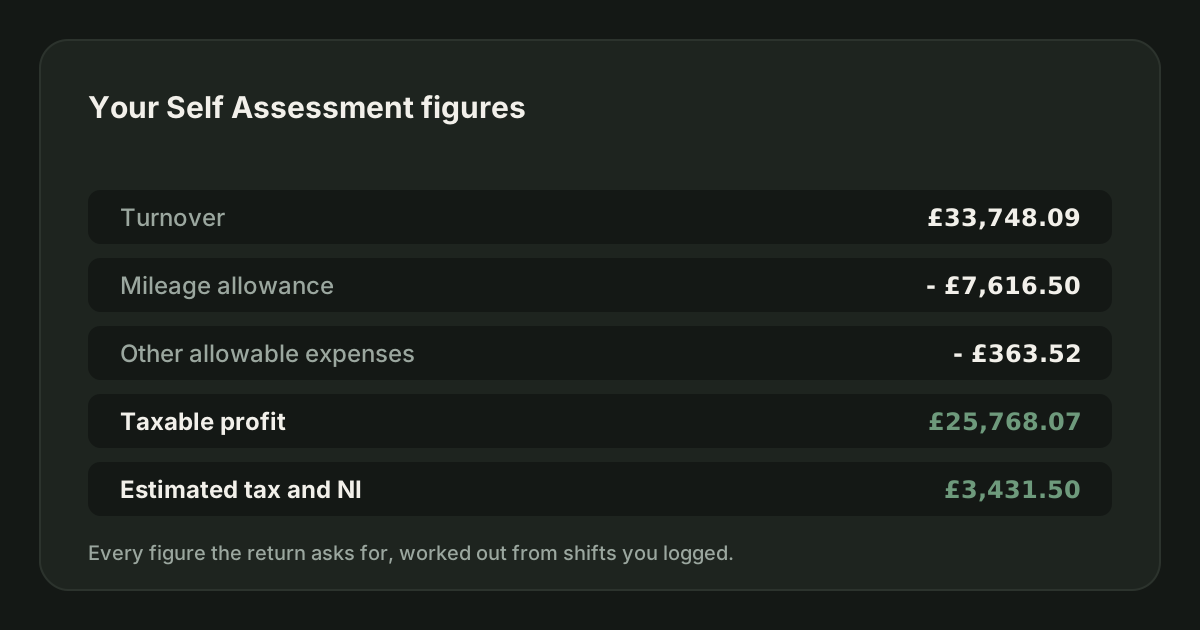
Your taxable profit is turnover minus allowable expenses. Tax is then charged on that profit in two separate ways.
Income tax. The first £12,570 of your total income is your personal allowance and is taxed at nothing. Above that you pay 20% up to £50,270, then 40%. If you also have a PAYE job, that job uses up your personal allowance first - which is why part-time drivers are often surprised by their bill. Income tax rates (opens in a new tab).
Class 4 National Insurance. 6% on profits between £12,570 and £50,270, then 2% above that.
Class 2 National Insurance stopped being compulsory from 6 April 2024. If your profits are £7,105 or more it is treated as paid, so you get a qualifying year toward your State Pension without paying anything. Below that it is voluntary at £3.65 a week (£189.80 a year) and is usually worth paying to protect your record. Self-employed National Insurance rates (opens in a new tab).
A worked example
A full-time driver with £30,000 of turnover and 19,000 business miles, all in a car:
| Amount | |
|---|---|
| Turnover | £30,000 |
| Mileage allowance (10,000 at 55p, 9,000 at 25p) | −£7,750 |
| Other allowable expenses | −£600 |
| Taxable profit | £21,650 |
| Income tax (20% on profit above £12,570) | £1,816 |
| Class 4 NI (6% on profit above £12,570) | £545 |
| Total to set aside | £2,361 |
That is roughly 8% of turnover - a long way from the "put a third aside" rule of thumb people repeat, because the mileage allowance does so much work. It also shows why guessing is a bad plan in both directions.
Payments on account
If your bill is £1,000 or more, HMRC asks for next year's tax in advance in two instalments. The first year this happens you pay your whole bill plus half of it again on 31 January, then the other half on 31 July. Drivers who have budgeted for the bill alone get caught by this every single January. Understand payments on account (opens in a new tab).
What are the Self Assessment deadlines?
Register by 5 October after the end of your first tax year of trading. File online by 31 January and pay what you owe the same day, or file on paper by 31 October. If you make payments on account, the second one is due on 31 July.
| Date | What |
|---|---|
| 5 October | Register for Self Assessment, after the end of your first tax year of trading |
| 31 October | Paper return deadline |
| 31 January | Online return deadline, and payment of the balance |
| 31 July | Second payment on account, if you make them |
Filing late is an automatic £100 penalty even if you owe nothing, and it climbs from there. Self Assessment deadlines (opens in a new tab).
Records you have to keep
Keep your records for at least 5 years after the 31 January filing deadline for that tax year. For a driver that means your platform statements, a mileage log, receipts for anything claimed on top of mileage, and your bank statements.
A mileage log is the one drivers most often lack, and it is the one HMRC is most likely to ask about. It needs the date, the purpose and the miles. A record made as you go is worth considerably more than a reconstruction made in January.
Making Tax Digital
Making Tax Digital for Income Tax started on 6 April 2026 for people with qualifying income above £50,000, dropping to £30,000 from April 2027 and £20,000 from April 2028. It means quarterly digital updates instead of one annual return, using compatible software. Note the threshold is on turnover, not profit, so plenty of full-time drivers are inside it. Making Tax Digital for Income Tax (opens in a new tab).
Where JoltMile fits
JoltMile keeps the records this guide says you need - every shift with its date, miles, hours and earnings, expenses with receipts attached - and applies the mileage rates and tax bands above as you go, so the figure you need in January exists in August. It exports the totals as CSV or PDF for your return or your accountant. It does not file for you.
Sources
Common questions
- Do I have to file a tax return as a delivery driver?
- If your delivery turnover before expenses was over the £1,000 trading allowance in a tax year, yes. It makes no difference whether it was your only work, whether you did it for three weeks, or whether you made a loss.
- What figures do I actually need?
- Your turnover from every platform, gross and before their fees; your business mileage for the year; and any other cost incurred wholly for the work. Everything else on the return follows from those three.
- Can I file it myself or do I need an accountant?
- Most gig drivers can file it themselves. The short self-employment pages want four numbers. An accountant earns their fee when you have a van, an unusual expense claim, or an HMRC letter.
- When is the deadline?
- 31 January after the end of the tax year, for filing online and for paying. Paper returns are due earlier, on 31 October, and registering for the first time has its own deadline of 5 October.
- What if I worked for four different apps?
- It is one self-employed trade, not four. Add the turnover together, add the expenses together, and report one set of figures on one set of pages.
About the author
Issac Davies, Founder of JoltMile
Issac Davies drives for gig apps in the UK and built JoltMile to show drivers what a shift actually pays once fuel, insurance and tax come off. Every guide here is checked against HMRC and gov.uk guidance, and is information rather than tax advice.
Track this automatically
Self Assessment · Estimated tax: the JoltMile app works this out from your own shifts. Your first 10 shifts are free.
Related
The complete mileage guide for delivery drivers
What counts as a business mile, the 55p and 25p approved rates, the 10,000-mile threshold, and whether mileage or actual costs leaves you better off.
Mileage & expensesUpdated 19/08/2026
Do I need to register as self-employed as a delivery driver?
Yes, if your delivery income before expenses was more than £1,000 in a tax year.
HMRC & taxUpdated 19/08/2026
How much tax will I pay as a delivery driver?
Income tax at 20% on profit above £12,570, plus Class 4 National Insurance at 6%.
HMRC & taxUpdated 19/08/2026
How JoltMile estimates your tax
Income tax and Class 4 National Insurance on your running profit, using the 2026/27 bands.
HMRC & taxUpdated 29/09/2026
Renting a PCO car: mileage rate or actual costs?
If you rent your private hire car by the week, you cannot claim both the rental and the mileage rate. Which one to claim depends on the rent, your miles and how much of the week the car works. Here is the arithmetic.
Mileage & expensesUpdated 29/09/2026
Amazon Flex or an Amazon delivery partner job?
There are two ways to deliver Amazon parcels. Flex is self-employed, in your own car, a block at a time. A Delivery Service Partner job is with a separate company that provides the van and usually sets a full day. They are different jobs with different tax.
Getting startedUpdated 29/09/2026