The complete mileage guide for delivery drivers
What counts as a business mile, the 55p and 25p approved rates, the 10,000-mile threshold, and whether mileage or actual costs leaves you better off.
Correct for the 2026/27 tax year. Last checked 12/09/2026.
Mileage is the largest single deduction most delivery drivers have, and the one most often got wrong - usually by claiming too little. This guide covers what counts, what it is worth, and how to keep a record that would survive a question from HMRC.
What are the HMRC mileage rates?
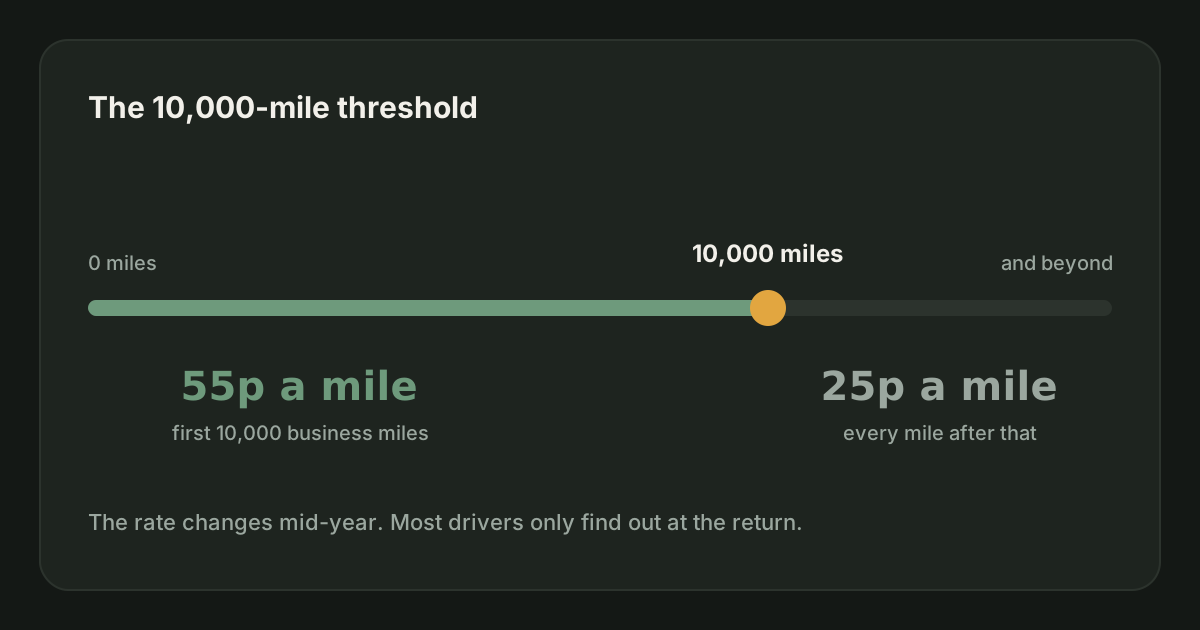
For a car or van, HMRC's approved rate is 55p a mile for the first 10,000 business miles in a tax year and 25p a mile after that. A motorcycle is 24p a mile and a bicycle 20p, with no threshold for either.
| Vehicle | Rate per business mile |
|---|---|
| Car or van, first 10,000 miles in the tax year | 55p |
| Car or van, every mile after that | 25p |
| Motorcycle | 24p (no threshold) |
| Bicycle | 20p (no threshold) |
The 10,000-mile counter resets every 6 April, and it is per vehicle type rather than per platform - miles for Amazon Flex and miles for Uber Eats go into the same total. HMRC approved mileage rates (opens in a new tab).
What counts as a business mile?
A business mile is one driven for the work itself. For a delivery driver that is essentially everything between arriving at your first pick-up and leaving your last drop-off:
- Depot or restaurant to the customer
- Customer to customer across a round
- Driving between pick-ups on a multi-app evening
- A trip back to the depot with an undelivered parcel
- Driving to a second warehouse mid-block
What does not count is ordinary commuting: home to the depot at the start, and the depot back home at the end. HMRC treats the journey to your normal place of work as private however far it is and however unpaid it feels.
Commuting miles still cost you real fuel, so they belong in your figures even though they are not claimable - that is exactly why JoltMile records them separately rather than ignoring them.
What does the mileage rate cover?
This is where drivers lose money by double-counting. If you claim the mileage rate, it covers every cost of running that vehicle:
- Fuel or charging
- Insurance
- Road tax
- MOT, servicing and repairs
- Tyres
- Breakdown cover
- Depreciation
So you cannot claim mileage and your fuel receipts, or mileage and your insurance premium. You can still claim parking, tolls, your phone, the platform's commission and kit, because none of those are the cost of running the car.
Mileage or actual costs?
Actual costs means claiming the business-use proportion of every real expense, plus capital allowances on the vehicle. It is more work, it needs receipts for everything, and once you use mileage rates for a vehicle you must keep using them for that vehicle.
A rough test: work out your total annual running cost including depreciation, take the business-use share, and compare it to your mileage claim. A driver doing 19,000 business miles claims about £7,750 under mileage. Beating that with actual costs generally needs an expensive or fast-depreciating vehicle. For a £4,000 runaround it is not close.
If you are buying a van, or a car that will lose a lot of value, run both numbers with an accountant before your first return - the choice is hard to unwind later.
Keeping a record HMRC would accept
There is no prescribed format, but a mileage record needs three things per journey or per working day: the date, the business purpose, and the miles. Odometer readings at the start and end of a shift are the strongest form.
A contemporaneous log - made as you go - carries far more weight than one reconstructed later from memory or from a maps app. Keep it for at least 5 years after the January filing deadline for that tax year.
JoltMile records the miles per shift as you log it, keeps business and commuting separate, and has a postcode-to-postcode distance calculator built into the shift wizard for when you did not read the odometer.
Common mistakes
- Claiming fuel receipts as well as mileage. Pick one.
- Counting home-to-depot as business. It is commuting.
- Forgetting the rate drops after 10,000 miles, and over-claiming.
- Keeping no record at all and estimating in January.
- Claiming 100% of the vehicle when family use it too, under the actual-costs method.
Sources
Common questions
- How much can I claim per mile?
- 55p a mile for the first 10,000 business miles in a tax year in a car or van, then 25p a mile after that. A motorcycle or moped is 24p a mile and a bicycle 20p, with no threshold for either.
- Can I claim fuel as well as mileage?
- No. The mileage rate covers fuel, insurance, servicing, repairs, road tax, MOT and the value the vehicle loses. Claiming any of those separately is claiming the same cost twice.
- Do I have to keep a mileage log?
- Yes, and it is the record HMRC is most likely to ask to see. A dated log of business journeys with the distance and the purpose is what makes the claim stand up; an annual estimate is not a record.
- Does the mileage figure in the app count?
- It is usually lower than your claimable mileage, because platforms measure paid distance and HMRC allows every business mile including the unpaid ones between jobs. Use your own odometer readings.
- Can I claim mileage on a bicycle or moped?
- Yes. 24p a mile on a motorcycle or moped and 20p on a bicycle, at the same rate all year: unlike the car rate, there is no threshold that lowers them partway through.
About the author
Issac Davies, Founder of JoltMile
Issac Davies drives for gig apps in the UK and built JoltMile to show drivers what a shift actually pays once fuel, insurance and tax come off. Every guide here is checked against HMRC and gov.uk guidance, and is information rather than tax advice.
Track this automatically
Business mileage · Distance calculator: the JoltMile app works this out from your own shifts. Your first 10 shifts are free.
Related
Self Assessment for delivery drivers: the complete guide
Registering, what counts as income, what you can claim, how much tax you will owe and when it is due - written for UK delivery and courier drivers, correct for the 2026/27 tax year.
HMRC & taxUpdated 19/08/2026
What counts as a business mile for a delivery driver?
Miles driven for the work itself - not the journey from home to your depot or zone.
Mileage & expensesUpdated 19/08/2026
Business mileage and the distance calculator
How JoltMile applies the 55p and 25p approved rates, tracks your 10,000-mile threshold, and works out distances from postcodes.
Mileage & expensesUpdated 29/09/2026
Can I claim mileage and fuel receipts?
No. The mileage rate already includes fuel, along with every other running cost.
Mileage & expensesUpdated 19/08/2026
Renting a PCO car: mileage rate or actual costs?
If you rent your private hire car by the week, you cannot claim both the rental and the mileage rate. Which one to claim depends on the rent, your miles and how much of the week the car works. Here is the arithmetic.
Mileage & expensesUpdated 29/09/2026
Your JoltMile subscription as a claimable expense
Why a JoltMile subscription appears in your expenses automatically, where the figure comes from, and why you cannot edit it.
Mileage & expensesUpdated 29/09/2026