Hire and reward against courier and food delivery cover
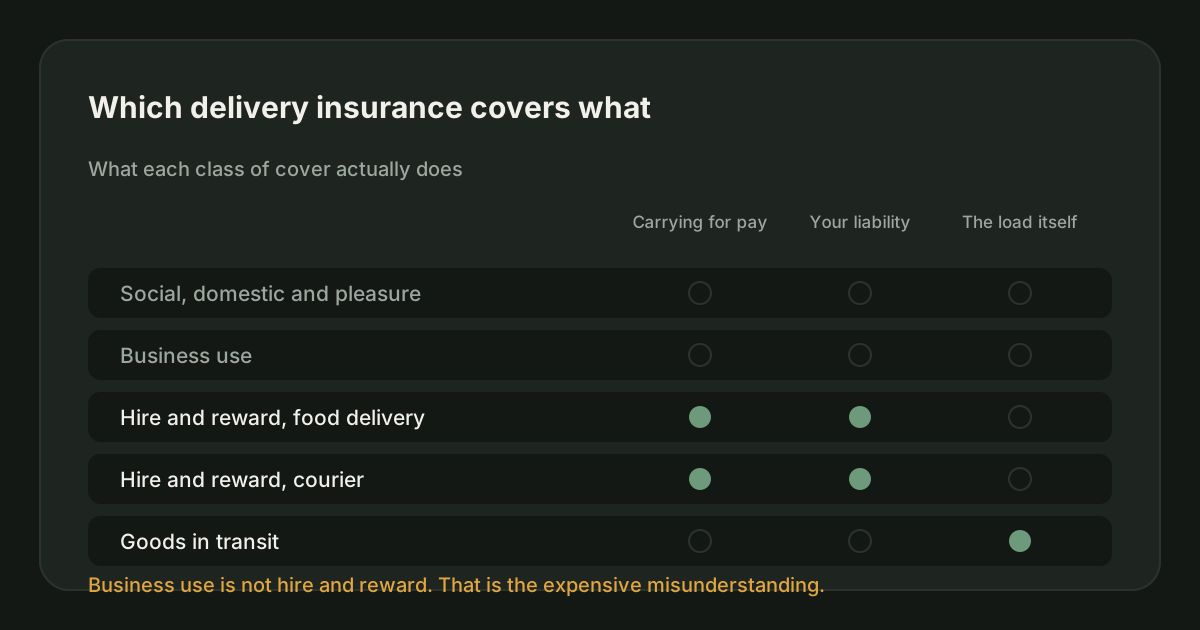
Hire and reward is the class of cover you need to carry goods or people for payment. Within it, food delivery cover suits short local hot-food runs, courier cover suits parcels, and goods in transit covers the value of what you are carrying rather than the driving.
Last checked 12/09/2026.
Insurance is the one thing in gig driving where getting it wrong is not a matter of a few pounds. It is the whole value of somebody else's car, your licence, and a criminal offence.
What each class means
| Class | What it covers | Enough for delivery? |
|---|---|---|
| Social, domestic and pleasure | Personal driving, and commuting if added | No |
| Business use | Driving in the course of your own occupation, between sites, to clients | No |
| Hire and reward | Carrying goods or passengers for payment | Yes, this is the class you need |
| Goods in transit | The value of the load, not the driving | An addition, not a substitute |
| Public liability | Injury or damage you cause to others outside the vehicle | An addition, sometimes required |
Inside hire and reward
Insurers split it by the kind of work, because the risks differ.
- Food delivery. Short local journeys, many stops an hour, low value loads, heavy urban driving. Priced for exactly that.
- Courier. Parcels, longer runs, higher load values, often more motorway. Usually more expensive and usually broader.
- Private hire. Carrying passengers. A different product again, and required by your licensing authority as well as by law.
What it costs and why
Delivery cover is more expensive than ordinary cover, sometimes by a lot, because the exposure is genuinely higher: more miles, more urban driving, more stopping, more time on the road at night. Treat it as a cost per mile rather than as an annual bill, and it goes into the calculation in what it really costs you per mile.
Getting it right
- Tell the insurer exactly what you do, including every platform, and get the answer in writing.
- Check the policy names the right class of use, not just that the quote was cheap.
- Tell them if the work changes. Adding parcel rounds to a food delivery policy is a change of risk.
- Keep the certificate somewhere you can produce it. Several platforms ask, and a licensing authority will.
What happens if you claim on the wrong policy covers the consequences in full.
Common questions
- Does business use cover delivery work?
- No. Business use covers driving to see clients or between sites in the course of your own job. Carrying goods or passengers for payment is hire and reward, and it is a separate class of cover that business use does not include.
- What is the difference between courier and food delivery cover?
- Food delivery cover is priced for short, frequent, local hot-food runs. Courier cover is priced for parcels, longer distances and higher values. Buying the cheaper one for the wrong work is the same problem as having no cover.
- Do I need goods in transit as well?
- It covers the value of what you are carrying, which your motor policy does not. For food delivery it is rarely worth it. For parcels, and particularly for anything high value, it usually is, and some contracts require it.
- Can I get cover by the hour?
- Some insurers sell pay-as-you-go hire and reward that you switch on for a shift. It suits genuinely occasional work and it is expensive per hour if you drive regularly.
- Does the platform insure me?
- Some platforms provide limited cover for parts of a trip, and none of it replaces your own policy. Read what it actually covers before relying on it, because the gaps are usually the expensive parts.
About the author
Issac Davies, Founder of JoltMile
Issac Davies drives for gig apps in the UK and built JoltMile to show drivers what a shift actually pays once fuel, insurance and tax come off. Every guide here is checked against HMRC and gov.uk guidance, and is information rather than tax advice.
Track this automatically
Insurance cost: the JoltMile app works this out from your own shifts. Your first 10 shifts are free.
Related
Insurance for delivery drivers: what you actually need
Hire and reward, courier cover, goods in transit and public liability - what each one is for, and why your ordinary car policy will not cover you.
InsuranceUpdated 19/08/2026
Hire and reward insurance
Hire and reward is the class of motor insurance that covers carrying goods or passengers for payment. Ordinary social, domestic and pleasure cover, and even business use, does not include it.
InsuranceUpdated 27/08/2026
Claiming on the wrong policy, and what happens
If you have an accident while delivering on a policy that does not cover hire and reward, the insurer can refuse the claim and can void the policy from the start. You are then personally liable for the other party's damage, and driving uninsured is a separate offence.
InsuranceUpdated 27/08/2026
Does my normal car insurance cover delivery work?
No. You need hire and reward cover, and driving without it is an offence.
InsuranceUpdated 19/08/2026
Private hire or food delivery: which is worth doing?
Private hire pays more per hour and costs far more to get into. Food delivery you can start this week with the car you already own.
Earnings & profitabilityUpdated 20/08/2026
What do I need to drive for Bolt?
A private hire driver licence from your local council, a licensed vehicle, and hire and reward insurance. The same requirements as any private hire work.
Getting startedUpdated 20/08/2026