What it really costs you per mile
Your cost per mile is fuel plus tyres, servicing, insurance, repairs and the value the car loses, divided by the miles you drive. Fuel is usually less than half of it, which is why a driver who only counts fuel thinks the work pays better than it does.
Correct for the 2026/27 tax year. Last checked 12/09/2026.
Ask a driver what a mile costs and most will answer with fuel. Fuel is the part you pay for visibly, weekly, at a pump. The rest arrives as a tyre in March and a clutch in October and a car worth two thousand pounds less than last year, and none of that feels like a cost per mile until you divide it.
The parts
| Cost | How it behaves | How to get a per-mile figure |
|---|---|---|
| Fuel or electricity | Weekly, visible | Price per litre divided by MPG, converted to pence per mile |
| Tyres | Every 15,000 to 25,000 miles | Set of tyres divided by the miles they last |
| Servicing | Annual, or by mileage | Annual cost divided by annual miles |
| Repairs | Unpredictable, and rising with age | A year of receipts divided by that year's miles |
| Insurance | Annual, fixed | Annual premium divided by annual miles |
| Road tax and MOT | Annual, fixed | Same |
| Depreciation | Invisible until you sell | Value lost over a year divided by that year's miles |
A worked example
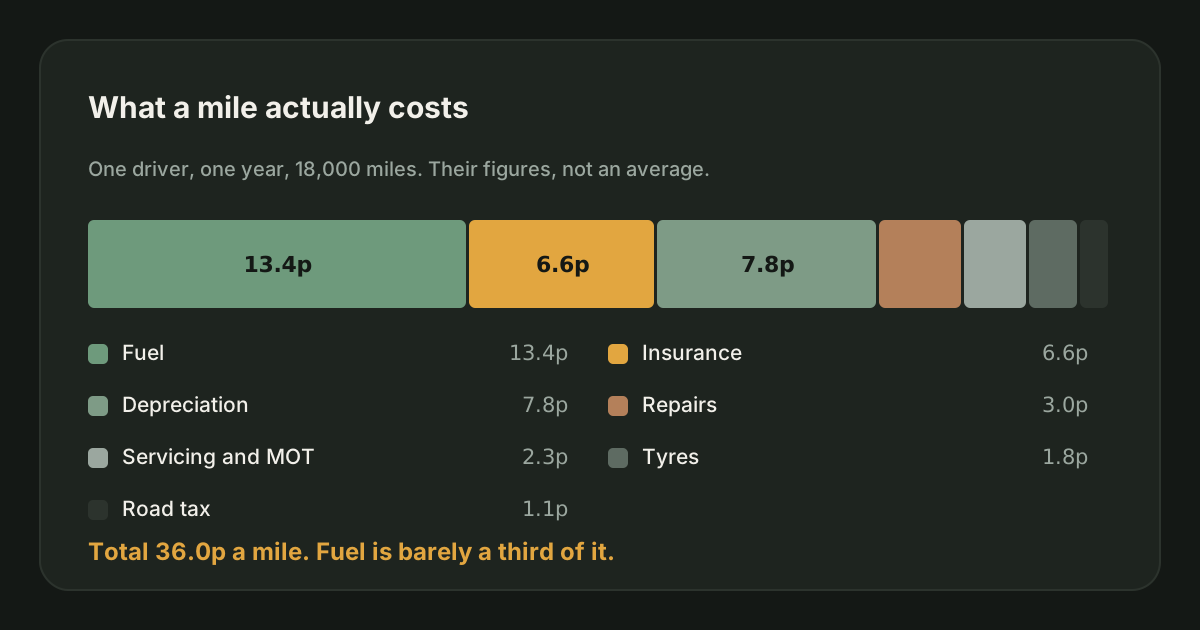
One driver, one year, 18,000 miles of which 14,000 were business. Their own figures, not an average.
| Cost | For the year | Per mile |
|---|---|---|
| Fuel, 48 MPG at £1.42 a litre | £2,420.00 | 13.4p |
| Insurance, hire and reward | £1,180.00 | 6.6p |
| Servicing and MOT | £420.00 | 2.3p |
| Tyres, one set | £320.00 | 1.8p |
| Repairs | £540.00 | 3.0p |
| Road tax | £195.00 | 1.1p |
| Depreciation | £1,400.00 | 7.8p |
| Total | £6,475.00 | 36.0p |
Fuel is 37% of it. The other 63% is the part that does not feel like a cost per mile until the year is added up.
Work out yours
- Take twelve months. A shorter window misses the annual bills, which is where most of the cost hides.
- Add up everything you spent on the vehicle: fuel, insurance, tax, MOT, servicing, tyres, repairs, breakdown cover.
- Work out what the car lost in value over those twelve months. Two valuations twelve months apart is close enough.
- Add the two together.
- Divide by the total miles the car did, business and private. That is your cost per mile.
- Multiply by your business miles to get what the work cost you in vehicle terms.
What to do with the number
Two things. It turns a job offer into a decision: a fixed fee minus the miles to earn it, at your real rate, is either worth doing or is not. And it feeds your real hourly rate, which is the only figure worth comparing between platforms. Your real hourly rate does the second half.
How this relates to the tax claim
Your cost per mile and the 55p mileage rate are different things and neither depends on the other. The rate is what HMRC lets you deduct. Your cost is what you actually spend. A driver in a cheap car is better off on the rate; a driver in an expensive one may not be, which is the calculation in simplified mileage against actual costs.
Sources
Common questions
- What is a realistic cost per mile for delivery driving?
- It depends entirely on the car and the mileage, which is why this guide shows you how to work out your own rather than quoting an average. A cheap, economical, already-depreciated car is a very different number from a three-year-old car on finance.
- Is fuel most of the cost?
- No. For most drivers fuel is somewhere between a third and a half. Tyres, servicing, insurance, repairs and lost value make up the rest, and they arrive as occasional large bills rather than weekly small ones, which is why they get forgotten.
- Does the mileage rate cover my real costs?
- The 55p rate is generous against a cheap economical car and thin against an expensive one doing high mileage. It is a tax rule, not a reimbursement, so whether it covers you is a separate question from whether you can claim it.
- Should I include depreciation if I own the car outright?
- Yes. The car is worth less every month whether or not you are paying anybody. Ignoring it means the day you replace the car arrives as a surprise rather than as a cost you had been carrying.
- How does cost per mile change what work I take?
- It turns a job into a decision. A £4.00 drop nine miles away at 30p a mile costs £2.70 to do, and that is before tax. The rate per mile matters more than the rate per job.
About the author
Issac Davies, Founder of JoltMile
Issac Davies drives for gig apps in the UK and built JoltMile to show drivers what a shift actually pays once fuel, insurance and tax come off. Every guide here is checked against HMRC and gov.uk guidance, and is information rather than tax advice.
Track this automatically
Fuel tracking · True hourly rate · Insurance cost: the JoltMile app works this out from your own shifts. Your first 10 shifts are free.
Related
Your real hourly rate, and how to work it out
Your real hourly rate is what the platforms paid you, minus what the vehicle cost you, minus the tax on the profit, divided by every hour you were working. It is commonly a quarter below the headline figure, and it is the only number worth comparing between platforms.
Earnings & profitabilityUpdated 27/08/2026
How much does delivery driving actually cost per mile?
Fuel is usually somewhere between 12p and 20p a mile for a typical petrol car, before wear, tyres, servicing and depreciation on top.
Vehicles & equipmentUpdated 20/08/2026
Fuel against electric for gig driving
On home charging an electric car is dramatically cheaper per mile than petrol, often by a factor of four or five. On public rapid charging the gap narrows to very little. Whether it works for you is mostly a question of where you charge, not of what you drive.
Vehicles & equipmentUpdated 27/08/2026
Net earnings
Net earnings are what is actually left after the costs of doing the work and the tax on the profit. It is the only figure worth comparing between platforms, and no app shows it.
Earnings & profitabilityUpdated 27/08/2026
Amazon Flex, Evri, DPD and Yodel: parcel work compared
Parcel work suits drivers who want daytime hours and a predictable load. The four big options differ on the vehicle they need, how you are paid, how often, and how much of the week they expect. Here they are side by side.
Earnings & profitabilityUpdated 29/09/2026
Car, moped or bike: which is best for delivery work?
A bike wins in a dense city centre, a moped wins in most towns, and a car wins on parcel work and bad weather. The tax relief follows the same order in reverse.
Vehicles & equipmentUpdated 20/08/2026