Claiming on the wrong policy, and what happens
If you have an accident while delivering on a policy that does not cover hire and reward, the insurer can refuse the claim and can void the policy from the start. You are then personally liable for the other party's damage, and driving uninsured is a separate offence.
Last checked 12/09/2026.
This is the largest financial risk in gig driving and it is one of the cheapest to remove. A driver saving a few hundred pounds a year on the premium is carrying a five-figure exposure to do it.
What the exclusion actually says
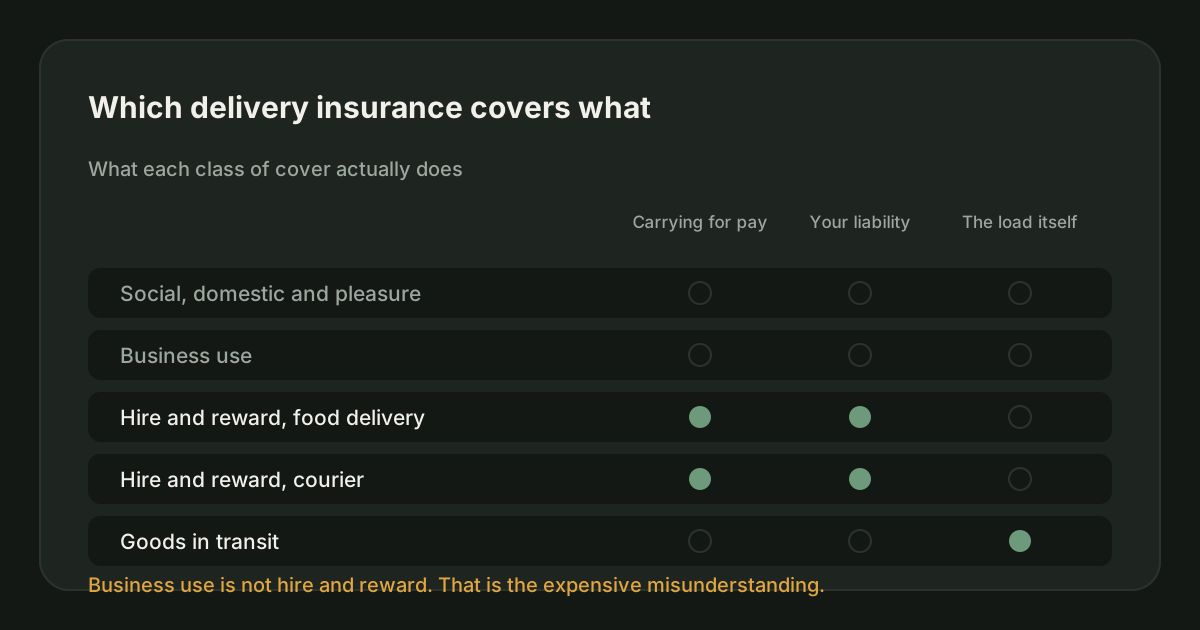
An ordinary motor policy covers social, domestic and pleasure use, and sometimes commuting or business use. Carrying goods or passengers for payment is a different class of use, hire and reward, and it is excluded. Business use does not include it; that is the most common misunderstanding.
What happens after an accident
- You claim. The insurer asks what you were doing at the time.
- It establishes you were delivering for payment, from your account, from the app, from the other party or from the goods in the car.
- The claim is refused, and the policy can be voided from inception.
- The other party is still paid, by their insurer or by the Motor Insurers' Bureau.
- Whoever paid can recover it from you personally. Your own car is not covered at all.
- The voided policy is declarable for years and every future quote reflects it.
The criminal side
Driving without valid insurance carries a fine, six to eight penalty points and the possibility of disqualification, and the police can seize the vehicle. A conviction then affects your insurance for years and can affect a private hire licence.
What platform cover does and does not do
Some platforms provide limited cover for parts of a trip. None of it replaces your own policy, and the gaps are usually the expensive parts: your own vehicle, and the periods between jobs. Read what it covers rather than assuming it fills the hole.
Fixing it
Tell your insurer exactly what you do and get the right class of cover. If you have been driving on the wrong policy, do not wait for a claim to find out. Hire and reward against courier and food delivery cover sets out which product matches which work.
Common questions
- Will my insurer really refuse the claim?
- If you were carrying goods for payment on a policy that excludes it, yes. It is not a technicality they might overlook; it is the difference between the risk they priced and the risk they carried.
- What does a voided policy mean?
- It is treated as never having existed. Any premium refunded, no cover for the incident, and you have to declare a voided policy on every insurance application for years, which raises the price of everything afterwards.
- Am I committing an offence?
- Driving without valid insurance is an offence in its own right, carrying a fine, penalty points and potentially disqualification, and the vehicle can be seized.
- What about the other driver?
- They are still compensated, through the Motor Insurers' Bureau where nobody is insured. The Bureau can then pursue you personally for what it paid out.
- What if I was not working at the time?
- Then the ordinary policy applies normally. The difficulty is proving it, and app data showing you logged in shortly before or after does not help you.
About the author
Issac Davies, Founder of JoltMile
Issac Davies drives for gig apps in the UK and built JoltMile to show drivers what a shift actually pays once fuel, insurance and tax come off. Every guide here is checked against HMRC and gov.uk guidance, and is information rather than tax advice.
Track this automatically
The JoltMile app works this out from your own shifts, and keeps the figures ready for Self Assessment. Your first 10 shifts are free.
Related
Hire and reward against courier and food delivery cover
Hire and reward is the class of cover you need to carry goods or people for payment. Within it, food delivery cover suits short local hot-food runs, courier cover suits parcels, and goods in transit covers the value of what you are carrying rather than the driving.
InsuranceUpdated 27/08/2026
Hire and reward insurance
Hire and reward is the class of motor insurance that covers carrying goods or passengers for payment. Ordinary social, domestic and pleasure cover, and even business use, does not include it.
InsuranceUpdated 27/08/2026
Does my normal car insurance cover delivery work?
No. You need hire and reward cover, and driving without it is an offence.
InsuranceUpdated 19/08/2026
What happens if I have an accident while working?
Your motor insurance handles the vehicle, provided the policy covers delivery. There is generally no sick pay, which is the risk self-employment carries.
Practical problemsUpdated 20/08/2026
Riding for Deliveroo: the full guide
How Deliveroo works for a rider: what you need to join, how each fee is worked out, the pay floor agreed with the GMB union, when the money arrives, the insurance Deliveroo gives you for free, and the parts that are left to you.
Getting startedUpdated 29/09/2026
Delivering for Uber Eats: the full guide
How Uber Eats works for a courier: signing up, how each delivery is paid, Quests and batched orders, the weekly pay cycle and the two ways to cash out early, the free Allianz cover, Uber Eats Pro, and the tax side.
Getting startedUpdated 29/09/2026