Business mileage and the distance calculator
How JoltMile applies the 55p and 25p approved rates, tracks your 10,000-mile threshold, and works out distances from postcodes.
Last checked 12/09/2026.
What it is
The miles you drove for the work, and the tax allowance they generate. JoltMile keeps business and commuting miles separate because HMRC treats them completely differently.
Why JoltMile asks for both
Business miles earn you a deduction. Commuting miles do not - but they still burn fuel, and leaving them out would make your hourly rate look better than it is. Both are recorded; only one reduces your tax.
How the allowance is calculated
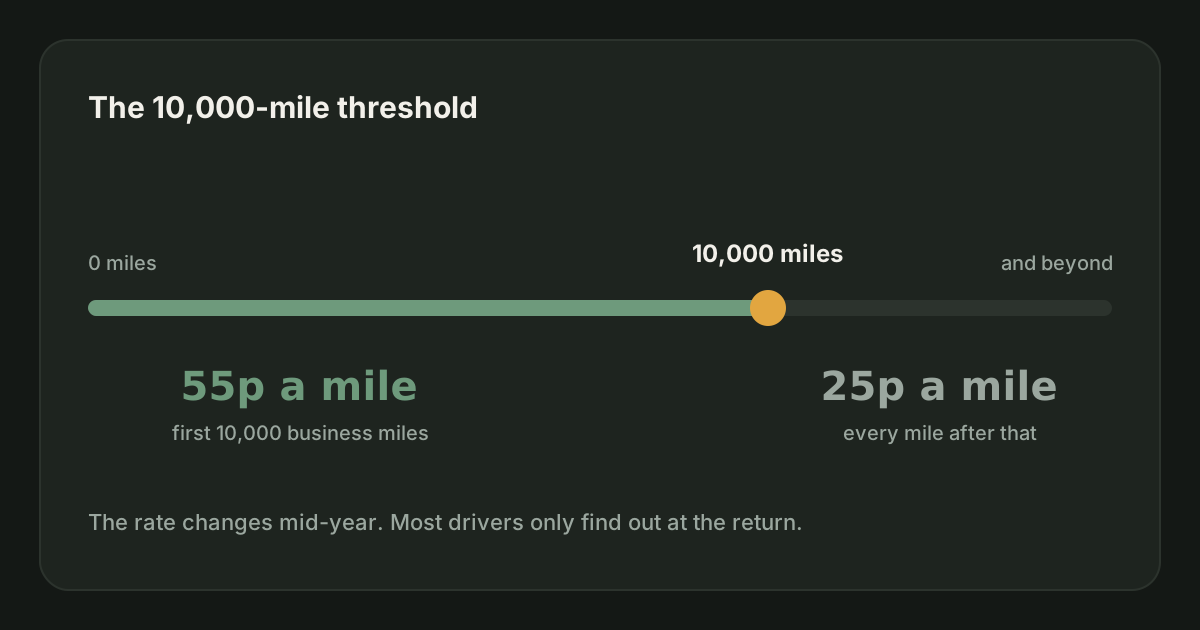
For a car or van, 55p for each of your first 10,000 business miles in the tax year, then 25p. Motorcycles are a flat 24p and bicycles 20p, with no threshold.
JoltMile carries your cumulative business miles forward across every shift in the tax year, so it knows exactly where you are against the threshold. A shift that straddles it is split: the miles below the threshold get the higher rate and the miles above it get the lower one, within the same shift. The counter resets on 6 April.
Miles measured, not estimated
Start a shift in the app and your miles are measured while it runs, so there is nothing to work out afterwards. Your commute is worked out from your home postcode and the postcodes where the shift started and ended, and you can change it before you save.
For a shift you log afterwards, use your odometer readings. Two readings are the best evidence of a business journey that there is.
Mistakes to avoid
- Guessing the miles for a shift you log afterwards. Odometer readings, or a timed shift next time, are both better than a guess.
- Recording commuting miles as business miles. It inflates your claim and it is the thing HMRC is most likely to query.
- Forgetting the return leg where it is genuinely business, such as a run back to the depot with undelivered parcels.
Related
The complete mileage guide for delivery drivers
What counts as a business mile, the 55p and 25p approved rates, the 10,000-mile threshold, and whether mileage or actual costs leaves you better off.
Mileage & expensesUpdated 19/08/2026
What counts as a business mile for a delivery driver?
Miles driven for the work itself - not the journey from home to your depot or zone.
Mileage & expensesUpdated 19/08/2026
Logging a shift
What each step of the shift wizard asks for, why, and what happens to it afterwards.
Getting startedUpdated 29/09/2026
Business miles, commuting and the depot run
A business mile is one driven wholly for the work. Commuting between home and a regular workplace is never claimable. For most gig drivers the working day starts when the app goes on, which makes the drive to a chosen pickup zone personal and the drive between drops business.
Mileage & expensesUpdated 27/08/2026
Record keeping, and how long to keep it
You have to keep enough to show how every figure on your return was arrived at: what you were paid, what you spent, and how far you drove for the work. Records have to be kept for 5 years after the filing deadline for the year they cover.
HMRC & taxUpdated 27/08/2026
Capital allowances on a vehicle
A capital allowance is tax relief on something you bought to keep and use, spread over years rather than deducted at once. You cannot claim capital allowances on a vehicle and use the mileage rate for it, so for most gig drivers this is a road not taken.
Mileage & expensesUpdated 27/08/2026