The 10,000 mile threshold, worked
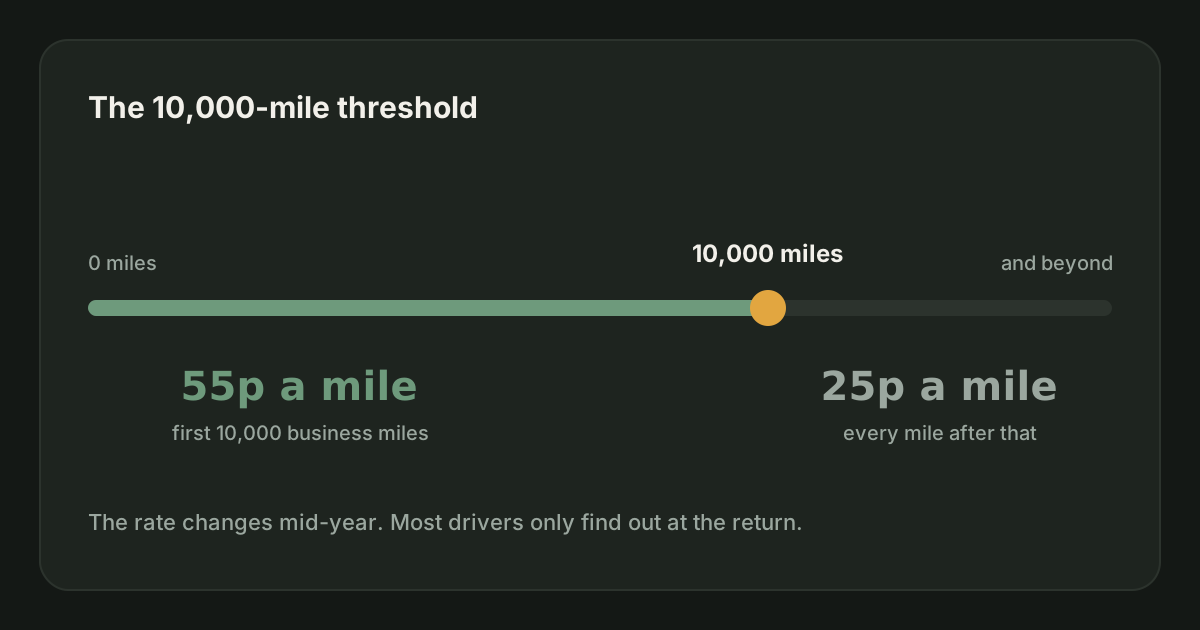
The mileage rate for a car drops from 55p to 25p after 10,000 business miles in a tax year. The threshold resets on 6 April, it counts business miles only, and a full-time driver usually passes it before the year is half done.
Correct for the 2026/27 tax year. Last checked 12/09/2026.
Most drivers know the rate is 55p. Fewer know it stops being 55p partway through their year, and for a full-time driver that happens sooner than expected.
The two rates
| Business miles in the tax year | Rate per mile |
|---|---|
| First 10,000 | 55p |
| Every mile after that | 25p |
Motorcycles and bicycles have their own single rates with no threshold at all.
A full year, worked
A driver covering 24,000 business miles in a tax year.
| Band | Miles | Rate | Claim |
|---|---|---|---|
| First 10,000 | 10,000 | 55p | £5,500.00 |
| Remainder | 14,000 | 25p | £3,500.00 |
| Total | 24,000 | £9,000.00 |
At a flat 55p the same mileage would have been £13,200.00. The threshold costs this driver £4,200.00 of deduction, which at basic rate plus Class 4 is around £1,180.00 of extra tax.
When you cross it
A full-time driver doing 500 business miles a week crosses 10,000 in twenty weeks, so around the end of August in a year starting in April. From that point the deduction per mile more than halves while the fuel cost does not change at all.
Does it change the method?
It is one of the few things that can. A very high-mileage driver in an expensive vehicle may find actual costs better precisely because so many miles fall at 25p. The decision is per vehicle and it sticks, so it is made before the first claim rather than after. Simplified mileage against actual costs covers it.
Sources
Common questions
- Does the threshold reset every year?
- Yes, on 6 April with the tax year. A driver who did 24,000 business miles last year starts the new year back on the higher rate.
- Is it per vehicle or per person?
- Per person, per tax year, across the business. Changing car halfway through the year does not give you a fresh threshold.
- Do personal miles count towards it?
- No. Only business miles count, which is another reason the log has to distinguish them.
- Why does the rate drop at all?
- The 55p rate is meant to include a contribution towards the fixed costs of having a vehicle: insurance, tax, depreciation. Once 10,000 miles have covered those, the 25p rate reflects only the running cost of an extra mile.
- Is the lower rate enough to cover my costs?
- Often not. 25p is close to fuel alone for many cars, which means a high-mileage driver is under-relieved on the miles above the threshold. It is a fixed rule rather than a reimbursement.
About the author
Issac Davies, Founder of JoltMile
Issac Davies drives for gig apps in the UK and built JoltMile to show drivers what a shift actually pays once fuel, insurance and tax come off. Every guide here is checked against HMRC and gov.uk guidance, and is information rather than tax advice.
Track this automatically
Business mileage · Estimated tax: the JoltMile app works this out from your own shifts. Your first 10 shifts are free.
Related
The complete mileage guide for delivery drivers
What counts as a business mile, the 55p and 25p approved rates, the 10,000-mile threshold, and whether mileage or actual costs leaves you better off.
Mileage & expensesUpdated 19/08/2026
AMAP (approved mileage allowance payments)
AMAP is the flat per-mile rate HMRC lets you claim instead of working out what your vehicle actually costs. For a car or van it is 55p a mile for the first 10,000 business miles in a tax year and 25p after that.
Mileage & expensesUpdated 27/08/2026
What happens after 10,000 business miles?
The rate drops from 55p to 25p per mile for the rest of the tax year. It resets every 6 April.
Mileage & expensesUpdated 19/08/2026
Mileage method or actual costs: which is worth more?
For most delivery drivers the mileage method wins, and it is not close. At 55p a mile it usually beats the real running cost of an ordinary car, and it needs no receipts.
Mileage & expensesUpdated 20/08/2026
Business miles, commuting and the depot run
A business mile is one driven wholly for the work. Commuting between home and a regular workplace is never claimable. For most gig drivers the working day starts when the app goes on, which makes the drive to a chosen pickup zone personal and the drive between drops business.
Mileage & expensesUpdated 27/08/2026
Record keeping, and how long to keep it
You have to keep enough to show how every figure on your return was arrived at: what you were paid, what you spent, and how far you drove for the work. Records have to be kept for 5 years after the filing deadline for the year they cover.
HMRC & taxUpdated 27/08/2026