Payments on account, explained with a first bill
A payment on account is an advance instalment towards next year's tax. HMRC asks for them once a bill passes £1,000, in two halves each worth 50% of the year just filed. It is why a first bill can be one and a half years of tax at once.
Correct for the 2026/27 tax year. Last checked 12/09/2026.
This is the single most common shock in gig driving finances, and it is entirely predictable once somebody explains it. Nobody usually does.
What a payment on account is
HMRC has no way of taking tax from you through the year, so once your bill is large enough it asks for next year in advance, in two halves. Each half is 50% of the bill for the year you have just filed. The threshold is £1,000.
A first bill, in full
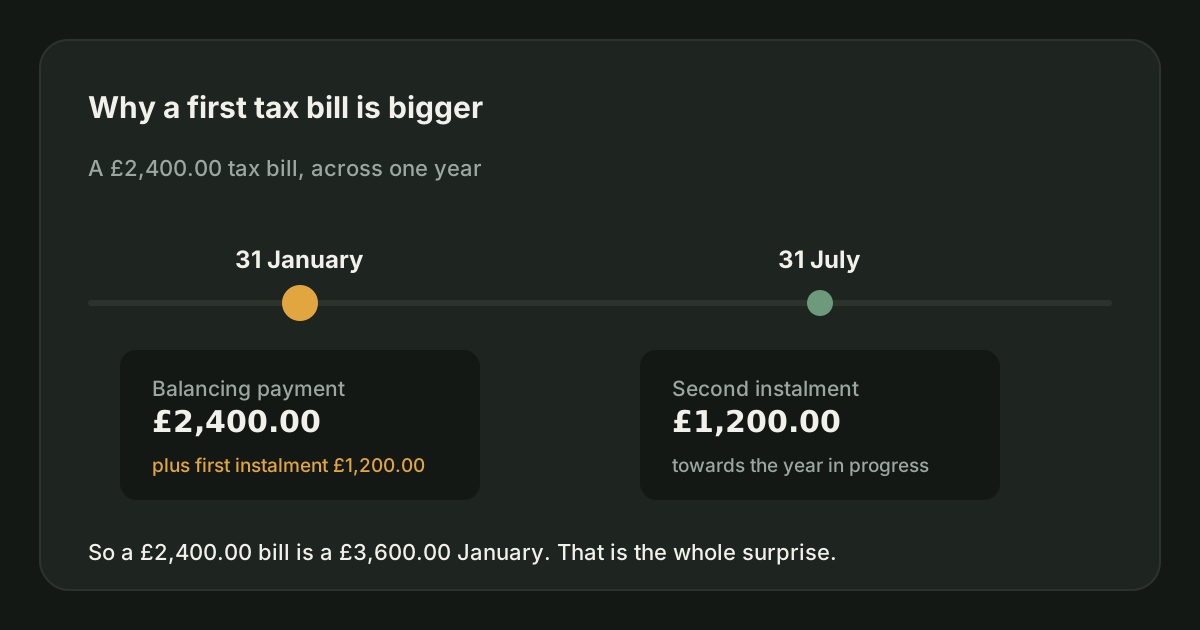
A driver files their first return and the calculation comes out at £2,400.00 of income tax and Class 4 National Insurance. Here is the year that follows.
| Date | What | Amount |
|---|---|---|
| 31 January | Balancing payment for the year filed | £2,400.00 |
| 31 January | First payment on account towards the next year | £1,200.00 |
| 31 July | Second payment on account | £1,200.00 |
| Paid across the year | £4,800.00 |
So a £2,400.00 tax bill is a £3,600.00 January. The following January is easier, because the two instalments already paid come off, and from then on it settles into a rhythm.
The year after
Say the next year comes out at £2,700.00. The two instalments of £1,200.00 have already been paid, so the balancing payment is £300.00, and the first instalment for the year after that is £1,350.00. January is £1,650.00 rather than £3,600.00.
Reducing them
- Work out honestly what you expect to owe for the year in progress, using your actual figures so far.
- If it is clearly lower than last year, make a claim to reduce payments on account through your HMRC online account or on the return itself.
- Keep the working. If HMRC asks why, you want the calculation rather than a feeling.
- Check again after the year ends. If you reduced them too far, pay the difference as soon as you know, because interest runs from the original due date.
Reducing them because money is tight rather than because income has fallen is the mistake that costs interest. The bill does not go away.
If you cannot pay
Contact HMRC before the deadline rather than after it. A Time to Pay arrangement spreads the bill and is far easier to arrange from a position of "here is my plan" than from a position of a missed payment. What if I cannot pay my tax bill covers it.
Sources
Common questions
- Why is my first tax bill 150% of what I calculated?
- Because it is the tax for the year you filed plus the first instalment towards the year after. The second instalment follows in July. Nothing has gone wrong and you have not been charged twice.
- When do payments on account start?
- Once your Self Assessment bill for a year is more than £1,000, and less than 80% of your tax was already collected at source. Below that threshold you simply pay the bill and nothing else falls due.
- Can I reduce my payments on account?
- Yes, if you genuinely expect to earn less. You can claim to reduce them through your HMRC account or on the return. Reduce them below what you end up owing and HMRC charges interest on the shortfall, so it is a judgement rather than a free option.
- Do payments on account ever stop?
- Yes, when your last bill was under £1,000, or when most of your tax is already taken at source through PAYE, or when your income stops. They do not stop simply because you would rather they did.
- Are payments on account extra tax?
- No. Every pound goes against the following year's bill. What they change is the timing, and for a driver in a first full year the timing is the whole problem.
About the author
Issac Davies, Founder of JoltMile
Issac Davies drives for gig apps in the UK and built JoltMile to show drivers what a shift actually pays once fuel, insurance and tax come off. Every guide here is checked against HMRC and gov.uk guidance, and is information rather than tax advice.
Track this automatically
Estimated tax · Compliance calendar: the JoltMile app works this out from your own shifts. Your first 10 shifts are free.
Related
Self Assessment for delivery drivers: the complete guide
Registering, what counts as income, what you can claim, how much tax you will owe and when it is due - written for UK delivery and courier drivers, correct for the 2026/27 tax year.
HMRC & taxUpdated 19/08/2026
Budgeting for a tax bill you have not had yet
Set aside a percentage of every payment as it arrives, into an account you do not spend from. For most full-time drivers claiming mileage, somewhere between 20% and 30% of what the platforms pay is enough, and the first year needs more because of payments on account.
HMRC & taxUpdated 27/08/2026
Payment on account
A payment on account is an advance instalment towards next year's tax bill. HMRC asks for them once your bill passes £1,000, in two halves, each equal to 50% of the year just filed.
HMRC & taxUpdated 27/08/2026
What if I cannot pay my tax bill?
File on time anyway, then set up a Time to Pay arrangement with HMRC. Interest still applies but the late-payment penalties can be avoided.
HMRC & taxUpdated 19/08/2026
Renting a PCO car: mileage rate or actual costs?
If you rent your private hire car by the week, you cannot claim both the rental and the mileage rate. Which one to claim depends on the rent, your miles and how much of the week the car works. Here is the arithmetic.
Mileage & expensesUpdated 29/09/2026
The 2026 VAT change on private hire, and what it means for drivers
From 2 January 2026 private hire operators can no longer use the Tour Operators' Margin Scheme, so operators that contract as principal pay VAT on the whole fare. It is a tax on the operator, not on you, but it changes fares and what drivers are offered.
HMRC & taxUpdated 29/09/2026